"Mum's just not eating." "Dad's lost weight, but he says he's fine."
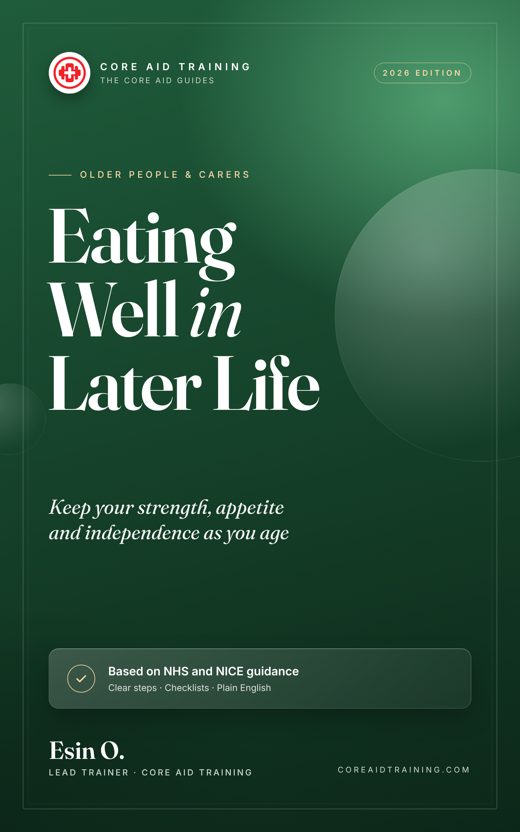
Losing weight without trying is not a normal part of getting older. It is a warning sign, and one of the most fixable problems in later life. This plain-English UK guide shows older people and their carers how to get enough energy, protein and fluid when appetite is small. It follows NHS, BAPEN and British Dietetic Association advice, and Resuscitation Council UK 2025 guidance for choking.
What is inside
- How to spot weight loss early, and how to ask for a 'MUST' screen
- Food first: little and often, fortified milk and easy ways to add nourishment
- Protein and muscle, to stay strong and steady
- Drinking enough without being up all night
- Constipation, mouth and swallowing problems, and what to do if someone chokes
- Vitamin D, calcium and bone health
- Cooking for one on a small budget, plus food banks, meals on wheels and benefits
- Diabetes and dementia: what changes at the table
- Care homes and hospital: what to ask
- Kind words to use when a proud parent says "I'm fine"
- Tools: weight and appetite tracker, two-week food first plan, fluid tracker, snack list, weekly menu ideas, shopping list, "About me" food sheet, GP visit sheet
Who it is for
Older people who want to stay strong and independent, and the families, friends and carers who cook for them.
Chapters
- Losing weight is not "just old age"
- When you're just not hungry
- Protein, muscle and staying strong
- Drinks, dehydration and the night-time toilet
- Keeping things moving: constipation
- Teeth, mouth and swallowing
- Bones, vitamin D and calcium
- Cooking for one, on a small budget
- Diabetes and eating in later life
- Dementia and eating
- In a care home or in hospital
- When to see your GP, and who else can help
A sample from the book
Who this book is for
This book is for two kinds of reader. Very often they share the same kitchen.
The first is you, if you are getting older and food has become harder work than it used to be. Perhaps you live alone now and cooking for one feels pointless. Perhaps you are just not hungry. Perhaps your trousers are looser and you thought, "Well, that's age, isn't it?" Perhaps chewing is tiring, money is tight, or the shops feel far away.
The second is you, if you cook for someone you love, or worry about how they are eating. A daughter who checks her dad's fridge every Sunday. A husband who has taken over the kitchen. A neighbour, a friend, a paid carer or a member of care home staff who wants to get this right.
Both of you are welcome here. Where a part speaks mainly to one of you, the heading will say so. Most of it is for both.
From the opening chapter of Eating Well in Later Life.
Questions people ask
Is Eating Well in Later Life written for the UK?
Yes. Based on NHS and NICE guidance. Phone numbers, services and the law are the UK’s, and the examples come from London training rooms.
How do I get the book?
It is a PDF. Pay by card on Gumroad and the download opens straight away, with a link emailed to you. Read it on a phone, tablet or computer, or print the pages you want.
Is this medical advice?
No. It is education in plain English, written by a first aid trainer. In an emergency call 999. For your own health, speak to your GP or NHS 111.
Can I get copies for my staff or residents?
Yes. For ten or more copies email info@coreaidtraining.com and we quote the same day.
Written by Esin O. FRSA, founder and lead trainer at Core Aid Training. Based on NHS and NICE guidance. Last reviewed November 2026.