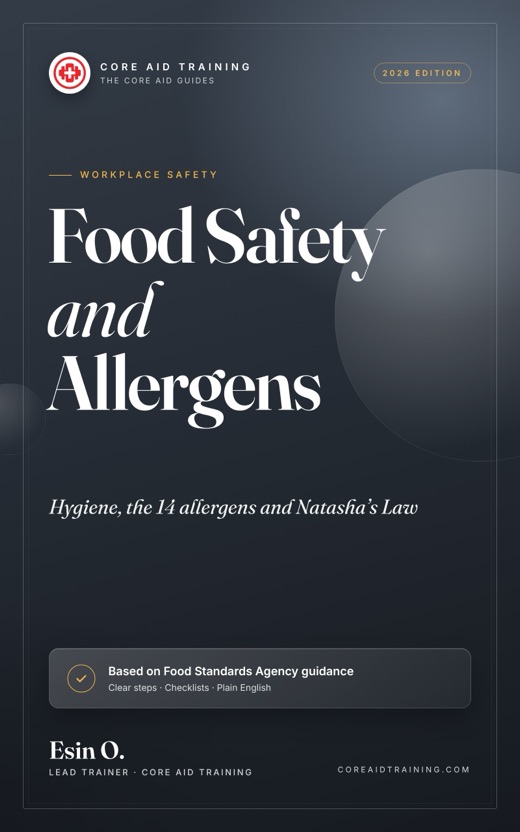
People trust you with their food. For someone with a serious allergy, they trust you with their life. This calm, practical guide helps you and your team deserve that trust, without drowning in paperwork.
Written in plain English for small food businesses in England, it explains what the law really asks, what inspectors look for, and the simple daily habits that keep food safe.
What is inside
- Food law in plain words, including registering 28 days before you trade
- The FSA's 4Cs: cleaning, cooking, chilling and cross-contamination
- The temperatures that matter: fridges, cooking, hot holding and reheating
- HACCP and Safer Food, Better Business explained simply
- Illness, hand washing and the 48-hour rule
- The 14 allergens and where they hide
- Natasha's Law, PPDS labels (with practice cases), the FSA's 2025 best practice and online orders
- Allergen order scripts your staff can use today
- Anaphylaxis first aid, step by step
- What training the law actually requires
- How to get, and keep, a 5 hygiene rating, plus the questions officers ask your staff
- Opening and closing checklists, fridge log, cooling and delivery records, allergen matrix, incident record, cleaning schedule and a four-week starter plan
Who it is for
Owners, managers and staff in cafés, restaurants, takeaways, caterers, market stalls, and care home and nursery kitchens.
Chapters
- Food safety law in plain words
- The 4Cs and cleaning that works
- Cooking, chilling and temperatures
- Cross-contamination, storage and deliveries
- Personal hygiene, illness and exclusion
- HACCP and Safer Food, Better Business
- The 14 allergens
- Allergen law and Natasha's Law
- Taking allergen orders safely
- When a reaction happens: anaphylaxis first aid
- Training your team
- Inspections and the food hygiene rating
- Your food safety toolkit
A sample from the book
You make food for people. Maybe it is breakfast rolls in a busy café, curries in a takeaway, birthday cakes from a market stall, lunch for forty children in a nursery, or soft meals for older people in a care home kitchen. Whatever it is, people trust you with something very personal. They put your food in their mouths, or in their children's mouths, without checking.
Most food businesses I meet are not careless. They are busy. They are short of staff. They have a dozen jobs before the doors open and a dozen more after they close. Food safety can start to feel like a pile of forms that someone made up to make your life harder. And allergens can feel frightening, because you have heard the stories and you worry that one mistake could hurt someone.
Here is the good news. Food safety is not complicated. It is a small number of simple habits, done every day, by everyone. When you understand why each habit matters, the forms stop feeling like paperwork and start feeling like protection: for your customers, your staff and your business.
From the opening chapter of Food Safety and Allergens.
Prefer to practise it with a trainer?
Reading gives you the calm explanation. A course gives you the muscle memory. Our Food Safety training runs on site at your kitchen or café across London, with certificates emailed the same day.
Questions people ask
Is Food Safety and Allergens written for the UK?
Yes. Based on FSA guidance. Phone numbers, services and the law are the UK's, and the examples come from London training rooms.
How do I get the book?
It is a PDF. Pay by card on Gumroad and the download opens straight away, with a link emailed to you. Read it on a phone, tablet or computer, or print the pages you want.
Is this medical or legal advice?
No. It is education in plain English, written by a first aid trainer. In an emergency call 999. For your own health, speak to your GP or NHS 111, and check official sources for the latest rules.
Can I get copies for my staff or residents?
Yes. For ten or more copies email info@coreaidtraining.com and we quote the same day.
Written by Esin O. FRSA, founder and lead trainer at Core Aid Training. Based on FSA guidance. Last reviewed November 2026.