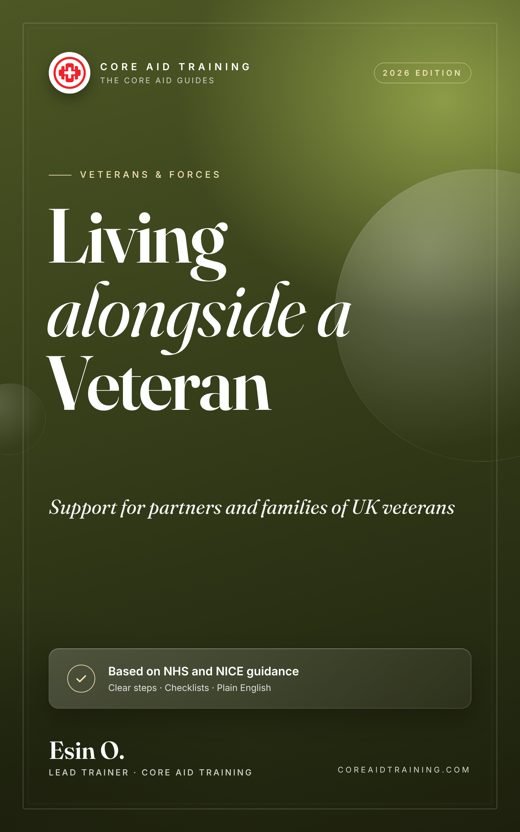
When someone leaves the Armed Forces, the whole family leaves with them. If the person you love has come home quieter, angrier, drinking more or just far away, this book is for you.
Written in plain, kind English, it helps you understand what might be going on, find the right words, and get real help, for them and for you.
What is inside
- What leaving the forces can feel like from the family's side
- PTSD, moral injury, anger and drink, explained simply (no diagnosing)
- Looking after your own mental health, including secondary trauma
- Talking to children of every age, and support for young carers
- Ready-to-use scripts for hard conversations, and a time-out plan
- What to do during a flashback or bad nightmare, and how to plan for Bonfire Night and anniversaries
- How to help someone accept help, and what to do if you are worried about suicide
- Domestic abuse: warning signs, a safety plan and helplines for each UK nation
- Money, housing, carers' rights and the carer's assessment
- Grief and loss, including grieving someone who is still here
- Up-to-date UK contacts, including VALOUR and MOD Veterans Services, plus a simple four-week plan to get started
Who it is for
Partners, husbands, wives, parents, grown-up children and close friends of UK veterans, whether they left last year or decades ago.
Chapters
- When service ends: the change from your side
- What might be going on: PTSD, moral injury, anger and drink
- Your own mind matters too
- Talking without fighting: words that help
- Getting them to accept help
- Children in a veteran family
- When home does not feel safe
- Money, housing and practical help
- You are a carer too: your rights
- Support made for partners and families
- Grief and loss
A sample from the book
This book is for the people who stand next to a veteran.
You might be a wife, husband or partner. You might be a mum or dad whose grown-up child has come home from the forces different. You might be a son or daughter, a brother or sister, or a close friend. You might live with them, or you might be the person they phone at midnight.
Whoever you are, you have probably noticed something. The person you love has left the Armed Forces, and home has not felt quite the same since. Maybe it has been a few months. Maybe it has been twenty years. Maybe things were fine for a long time and then, slowly, they were not.
You may be carrying a lot. Worry about them. Worry about the children. Worry about money. Tiredness from walking on eggshells. Guilt for feeling angry. Loneliness, because it is hard to explain to friends who have never lived this life.
This book is here to help you understand what might be going on, to give you words for hard conversations, and to show you where real help is. It is also here to say something you may not hear often enough: your life matters too. Not just as a helper. As a person.
From the opening chapter of Living Alongside a Veteran.
Questions people ask
Is Living Alongside a Veteran written for the UK?
Yes. Based on NHS and NICE guidance. Phone numbers, services and the law are the UK’s, and the examples come from London training rooms.
How do I get the book?
It is a PDF. Pay by card on Gumroad and the download opens straight away, with a link emailed to you. Read it on a phone, tablet or computer, or print the pages you want.
Is this medical advice?
No. It is education in plain English, written by a first aid trainer. In an emergency call 999. For your own health, speak to your GP or NHS 111.
Can I get copies for my staff or residents?
Yes. For ten or more copies email info@coreaidtraining.com and we quote the same day.
Written by Esin O. FRSA, founder and lead trainer at Core Aid Training. Based on NHS and NICE guidance. Last reviewed November 2026.