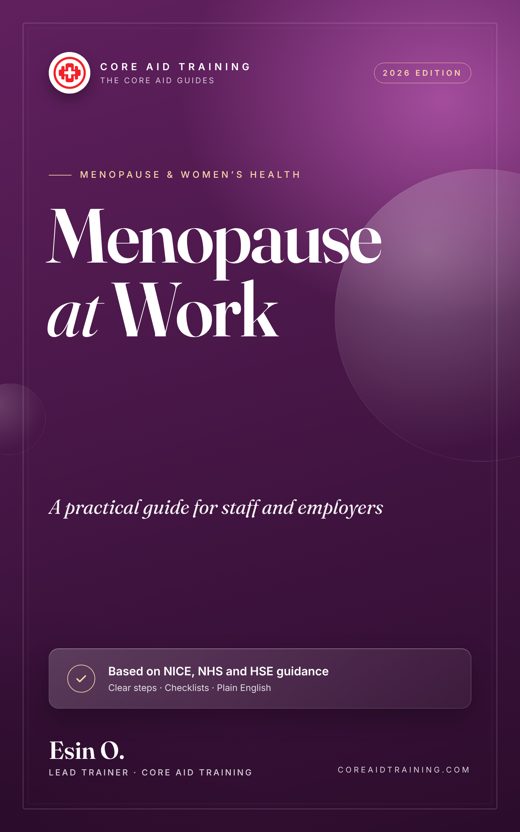
Hot flushes in meetings. Brain fog on a busy shift. Heavy periods when you can't leave your post. Menopause affects millions of working people, and too many struggle in silence.
This warm, practical guide is written in plain English for two groups: people going through perimenopause or menopause at work, and the managers and small employers who want to support them and get the law right.
What is inside
- What perimenopause and menopause are, and the full range of physical and psychological symptoms
- How to talk to your GP, and an outline of HRT and non-hormonal options, in line with NHS and NICE guidance
- Practical ways to cope with heat, poor sleep, brain fog, anxiety and heavy bleeding at work
- Menopause in physical and hands-on jobs, including safer lifting with TILE
- How to ask for adjustments, and flexible working rights
- The legal picture for employers in plain English: risk assessment, the Equality Act 2010, reasonable adjustments, absence and confidentiality, plus what the Employment Rights Act 2025 changes
- Support for trans, non-binary and intersex staff
- A clear guide to when to call 999, NHS 111, your GP or a pharmacist
- Five ready-to-use templates: symptom diary, conversation planner, manager's checklist, risk assessment table and one-page policy starter, plus a follow-up email and a worked example
Who it is for
Anyone going through menopause at work, line managers, small business owners, HR leads and supervisors.
Chapters
- What is happening to my body?
- Talking to your GP and your treatment options
- Getting through the working day
- Menopause and your mind
- Menopause in physical and hands-on jobs
- Asking for what you need
- The law in plain English
- Making work fit: risk assessment and adjustments
- Conversations, confidentiality and absence
- A menopause policy and trained managers
- Trans, non-binary and intersex people and menopause
- Your toolkit: templates to copy and use
A sample from the book
Menopause is not a rare event. It is not a niche topic. If you work with people, you work with people who are going through it, have been through it, or will go through it. Some of them are sitting next to you. One of them might be you.
And yet, for a long time, many workplaces treated it as something to whisper about, or joke about, or not mention at all. People pushed through hot flushes in meetings. They hid how little they had slept. They wondered if they were losing their minds because they forgot a word they had used every day for twenty years. Some left jobs they loved because they did not know what was happening or how to ask for help.
This book is here to change that, one workplace at a time.
From the opening chapter of Menopause at Work.
Prefer to practise it with a trainer?
Reading gives you the calm explanation. A course gives you the muscle memory. Our Mental Health First Aid course runs on site at your workplace across London, with certificates emailed the same day.
Questions people ask
Is Menopause at Work written for the UK?
Yes. Based on NICE, NHS and HSE guidance. Phone numbers, services and the law are the UK’s, and the examples come from London training rooms.
How do I get the book?
It is a PDF. Pay by card on Gumroad and the download opens straight away, with a link emailed to you. Read it on a phone, tablet or computer, or print the pages you want.
Is this medical advice?
No. It is education in plain English, written by a first aid trainer. In an emergency call 999. For your own health, speak to your GP or NHS 111.
Can I get copies for my staff or residents?
Yes. For ten or more copies email info@coreaidtraining.com and we quote the same day.
Written by Esin O. FRSA, founder and lead trainer at Core Aid Training. Based on NICE, NHS and HSE guidance. Last reviewed November 2026.