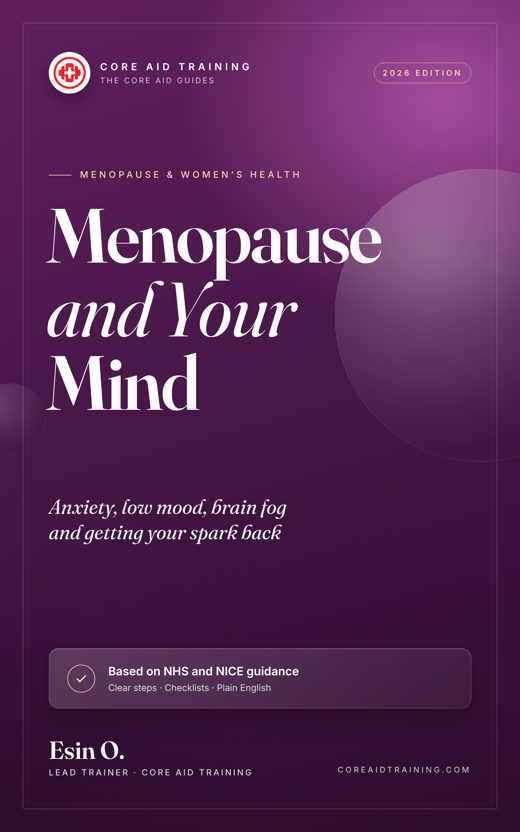
Heart racing in the supermarket queue. Awake at 3am, again. Losing words mid-sentence. Snapping at people you love, then lying awake feeling ashamed. If you have started to wonder "what is wrong with me?", this book is for you.
Menopause and Your Mind is a warm, frank, plain-English guide to the mental side of perimenopause and menopause. It explains why hormones affect your mood and thinking, and gives you real tools to feel calmer, clearer and more like yourself again.
What is inside
- Why hormones affect mood, sleep, memory and confidence, in plain words
- Anxiety and panic: a step-by-step "ride the wave" plan
- Low mood, tears and rage, with a pause plan and how to repair after an outburst
- Brain fog and memory worries, and when to get checked
- Sleep and the 3am mind
- Menopause, depression or something else? Clear signs and who to contact, and how fast
- How to talk to your GP, with plain-English notes on what the NICE menopause guideline says about HRT and CBT for mood
- CBT tools to try at home: thought records, worry time, calm breathing
- Relationships, family and work, plus how to support a struggling colleague
- A simple four-week plan to get your spark back, and what to do when you have a setback
- Tools: mood and symptom tracker, worry time sheet, wellness action plan, "letter to myself"
Who it is for
Women in perimenopause or menopause whose mood, confidence or thinking has changed, at home or at work, and the people who support them.
Chapters
- Why hormones affect your mind
- Anxiety and panic
- Low mood, tears and feeling flat
- Irritability and rage
- Brain fog and memory worries
- Sleep, night sweats and the 3am mind
- Confidence and who you are now
- Menopause, depression or something else?
- Talking to your GP
- CBT tools you can try at home
- Relationships and family
- At work: looking after yourself and others
- Getting your spark back
- Your toolkit
A sample from the book
Something has changed, and you have noticed.
Maybe you used to be the calm one. The one who held it together at work, remembered every birthday, and knew where everyone's PE kit was. Now your heart races in the queue at the bank. You lie awake at 3am going over a conversation from last Tuesday. You walk into a meeting and the word you need simply is not there.
Maybe you cry at adverts. Maybe you do not cry at all, and you just feel flat, like someone has turned the colour down on your life.
Maybe you have snapped at your children, your partner or a colleague, and then felt so ashamed that you could not sleep.
And maybe the hardest part is the quiet question underneath it all: What is wrong with me?
Here is my honest answer. Probably nothing is "wrong" with you as a person. Your brain is going through a big change. The hormones that helped steady your mood, your sleep and your thinking for decades are shifting. For many women, that shows up first in the mind, long before the hot flushes start or the periods stop.
What you are feeling is real. It has a cause. And a great deal can help.
From the opening chapter of Menopause and Your Mind.
Prefer to practise it with a trainer?
Reading gives you the calm explanation. A course gives you the muscle memory. Our Mental Health First Aid course runs on site at your workplace across London, with certificates emailed the same day.
Questions people ask
Is Menopause and Your Mind written for the UK?
Yes. Based on NHS and NICE guidance. Phone numbers, services and the law are the UK’s, and the examples come from London training rooms.
How do I get the book?
It is a PDF. Pay by card on Gumroad and the download opens straight away, with a link emailed to you. Read it on a phone, tablet or computer, or print the pages you want.
Is this medical advice?
No. It is education in plain English, written by a first aid trainer. In an emergency call 999. For your own health, speak to your GP or NHS 111.
Can I get copies for my staff or residents?
Yes. For ten or more copies email info@coreaidtraining.com and we quote the same day.
Written by Esin O. FRSA, founder and lead trainer at Core Aid Training. Based on NHS and NICE guidance. Last reviewed November 2026.